The general contractor is the hub for all subcontractors, architects, engineers, owners, and other parties involved in a construction project. Any communication between the parties can only be routed appropriately by the GC. Hence, it becomes GC's responsibility to duly forward a submittal from the creator to the responsible parties for processing by setting up a workflow.
Note:
- Stand-alone Project: A self-contained scope of work in Linarc managed entirely by a single contractor without the involvement of other subcontractors. The contractor is solely responsible for all planning, execution, costs, and deliverables.
- For standalone projects, in-app workflow sequences do not apply to external stakeholders.
- Instead of setting up successive workflow steps in Linarc, the submittals can be downloaded as a PDF and then attached to email.
- See Email a Submittal to External Stakeholders for more details.
Once the workflow is set up, Linarc automatically moves the item to respective companies in successive steps for their actions as per the workflow.
The submittal workflow governs the routing of submittals to respective parties at successive stages in order. For example, a submittal created by an SC is routed, the submittal manager of the GC reviews and sets up a suitable workflow for the submittal. See Submittal - Workflow for more details
You can perform an initial review of the submittals and move forward with setting up a workflow for legitimate ones.
- Forward for Review and Approval - If the submittal deserves clarifications from other stakeholders, you can set up a workflow and forward it to the next step, typically to the design team.
- Respond- Depending on the context, you can respond to the submittal. You can still set up a workflow and forward the submittal to the responsible party for the responses. See Submit a Submittal for more details.
- Delete - If you can answer the submittal through other communication means like the built-in collaboration or if the submittal is trivial, you can reject the submittal by deleting it. See Delete a submittal for more details
To open the submittal
- Ensure that you are in the 'Submittals' module of the project. If not,
- Click the main menu at the top-left
- Click 'Submittals' under 'Documents' and click 'Boards' on the left
- Open the submittal from the 'Drafts' or 'In Progress' column
- Drafts: Displays submittals created by you and members of your company.
- In Progress: Shows submittals from other companies. Submittals that require your attention are marked as 'Open' and tagged with 'You' in blue, indicating they are assigned to you
To set up a workflow for the submittal
- Click the 'Workflow' tab
- Choose a template depending on the creator, the context, and the entities responsible for various actions on the submittal.
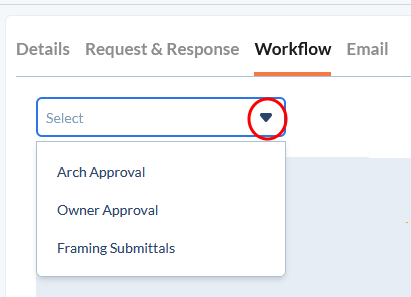
Tip: If the template you want to choose is not available in the list, first add the template to the project. See Configure Workflow Templates for the Project Documents to learn more.
Once chosen, the sequence of steps, with the actions and the responsible company types in each step shown as a list.
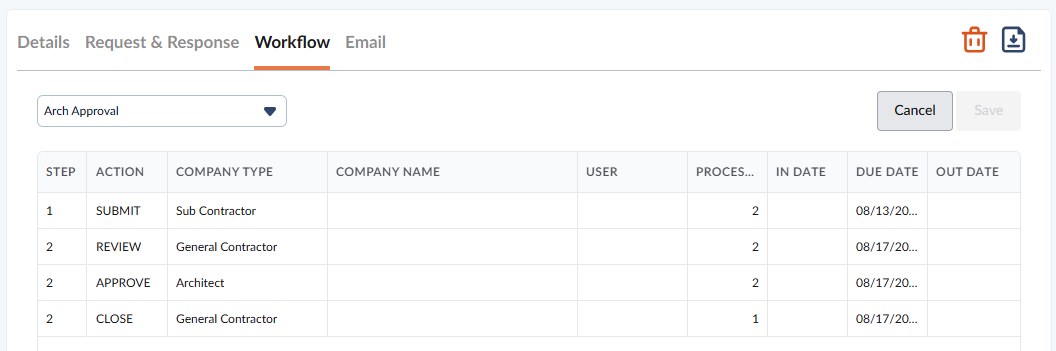
Note: The 'Create' step is completed by default and will appear in the list of actions once the workflow is saved. You can only configure the responsible companies and set durations for each action in the subsequent steps.
- Step - The serial number of the step gets auto-populated once the workflow is saved and published. In cases where the 'Review' or 'Approval' action is configured for parallel execution, the workflow table will display a unique row for each assignee, all sharing the same serial number to indicate they occur simultaneously.
- Action - The activity involved. The action can be a request, submission, review, approval, etc. This is pre-populated from the chosen workflow template.
- Company Type- The role of the contractor company in the project. This can be the general contractor, subcontractor, architect, etc.
- Company Name- The business name of the company. You can choose the company from the respective drop-downs. Any team member from the company with the required permissions can perform the action.
- Click inside the 'Company Name' field and choose the company from the options.
For 'Review' and/or 'Approve' steps designated as parallel, specify the stakeholders required for simultaneous review or approval. Upon completion of the preceding step, Linarc automatically routes the submittal to all selected companies concurrently. The workflow advances to the next stage only after every assigned party has completed their action, ensuring all feedback is captured before proceeding.
- Process Days- The maximum permissible days for the activity. The number of days allowed for each step is inherited from the respective values specified in the template by default. You can manually edit them as required. The 'Due Date' for each step auto-updates depending on the set process days.
- Double-click inside the 'Process Days' field to manually enter the number of days.
- In Date - The date on which the submittal was received for the action from the previous step.
- Due Date - The target completion date of the activity. The date is auto-populated based on the completion date of the previous step and the allowed process days of the current step, excluding weekends and holidays.
- Out Date - The date on which the action was completed.
- Status - Whether the action is complete, pending, or in processing.
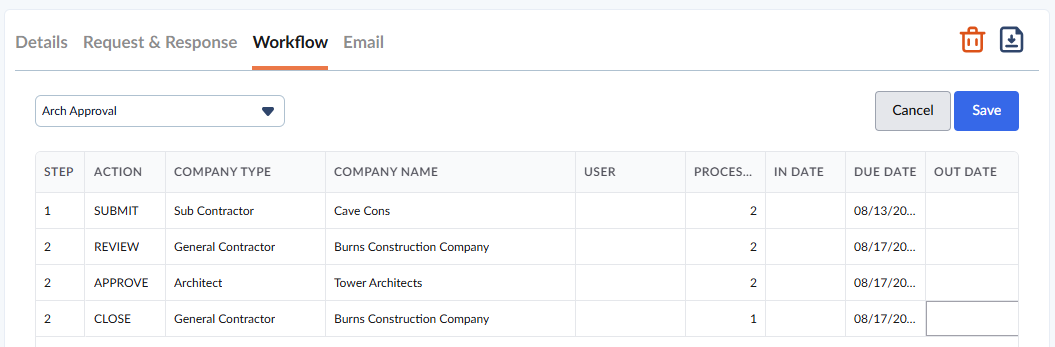
- Click 'Save' to apply the workflow to the submittal.
- Click the 'Edit Workflow' button to change the assignee companies and/or the process days, if required. You cannot add or remove steps or change the sequence of actions by editing.
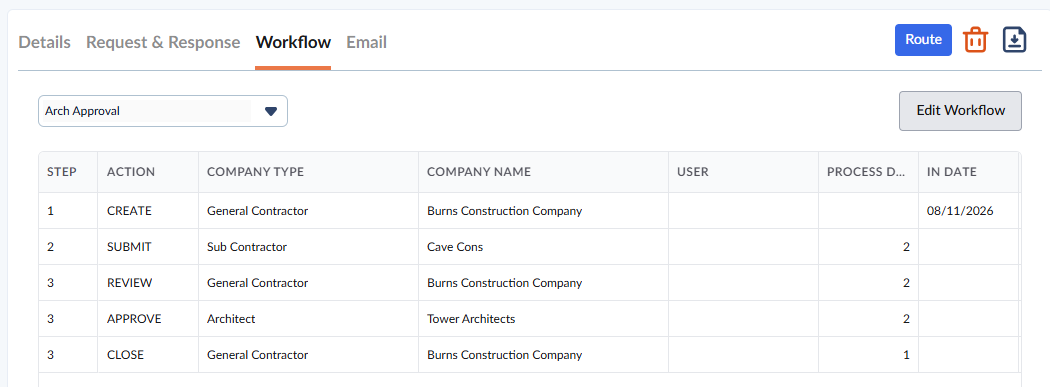
- Click the
 button on the top right to forward the submittal to the next step.
You can view the status of the submittal in its workflow at any time by clicking the 'Workflow' tab.
Was this article helpful?
That’s Great!
Thank you for your feedback
Sorry! We couldn't be helpful
Thank you for your feedback
Feedback sent
We appreciate your effort and will try to fix the article